The market isn't moved by people like you and me
Here's something most trading courses won't tell you straight.
The market isn't moved by people like you and me. It's moved by banks and funds. Their orders are so big, they decide where price goes.
And every weekday at 9:30, when New York opens, they all walk in at once.
For about five minutes, there's a fight. Buyers on one side, sellers on the other. On your chart it looks like nothing much. One five-minute candle: a single bar showing those five minutes of trading.
Then one side wins. And when it does, it leaves a footprint.
Big money can't move quietly. An elephant can't walk through mud without leaving a mark. When the winning side pushes, price breaks out of that first candle so fast that it skips a stretch of prices completely. On the chart it looks like a hole. That hole is the footprint.
It's not a secret. It's been on your chart every single morning. Most people just aren't looking at 9:30.
Why guessing was always going to lose
So why haven't you seen it? Because almost everything you've been taught asks you to guess.
Indicators, patterns, the trend: they all ask you to pick a side before the market has shown you anything. This waits until the first five minutes are over and the move has already started. And whoever picks a side before the big money moves ends up standing in front of it.
And most traders are taught to put their stop (the price where a losing trade closes itself) in the same obvious place: just under the last low. When everyone's stop sits in one spot, price often dips there first, takes those stops out, and then carries on. I show you exactly this on real charts in the course.
That's why a trade can go your way and still stop you out first. It's why you can do everything "properly" and still finish the month down.
But it's not about you. It's about the process you were given. These aren't stupid people. They're smart people who were given too many tools and not enough rules.
Old way
The 5-Minute Footprint
14-day money-back guarantee
You can't trade like the banks. You can follow them.
Most courses will tell you to "trade like the institutions". You can't. You don't have their money, their data or their speed.
But you don't need to beat them. You don't even need to predict them. They've got one problem you don't: they're too big to hide.
So you wait for the fight at the open to end, on one chart: the Nasdaq, the index of the big US tech companies. You look for the footprint. You go the same way until you've made twice what you risked. Then you're out.
Yes, it's a breakout. But it's not "buy any breakout". A high getting broken means nothing on its own: that's exactly where retail traders get taken. This is one break, of the first candle at the open, only when it leaves a footprint. And I'm out at twice what I risked. I don't hang around to see if it comes back.
Built to be wrong six times out of ten
Here's the part most traders don't believe until they do the maths.
You don't need to win most of your trades. Say you risk the same amount on every trade, $100 for example. Use whatever size suits you. When a trade works, you make $200. When it doesn't, you lose $100.
Win 4 out of 10, and that's $800. Lose the other 6, and that's $600. You're ahead.
That only works because the target is fixed at twice your risk, set before you click, and you never move it.
Some months it wins six out of ten. In a bad stretch, three. At three out of ten you lose: three wins make 6 times your risk, seven losses cost 7. That's why the rules matter more than the setup. DA APPROVARE con Joey: i suoi numeri su questo modello
- One win and you're done. Made twice what you risked? Shut the charts. Don't give it back.
- Two losses and you're done. If you lose twice, it's just not your day. Come back tomorrow.
- Same dollar risk on every trade. Don't size up after a win. Don't size down after a loss.
The strategy isn't what makes you profitable. The rules are.
Your savings stay out of it
Here's what most people outside trading don't know yet. You don't need $50,000 to trade $50,000 anymore.
Prop firms let you trade their capital. You pay the firm for a test, called an evaluation. Pass it, and from then on you trade their money and get paid a share of the profit. DA VERIFICARE: quota del profitto delle firm che consigliamo
The honest part: if you fail an evaluation, that fee is gone. That's what the 3 Rules are for. They stop the one bad morning that fails most people's test.
So the most you put on the line is the firm's fee, never your savings. And on every trade, you know the most you can lose before you click.
One trade a day. At the open that fits your day: London, New York or Asia. Without predicting anything. Without sitting in front of a screen all day. Even if you've never placed a trade, and even if you've lost money trying before.
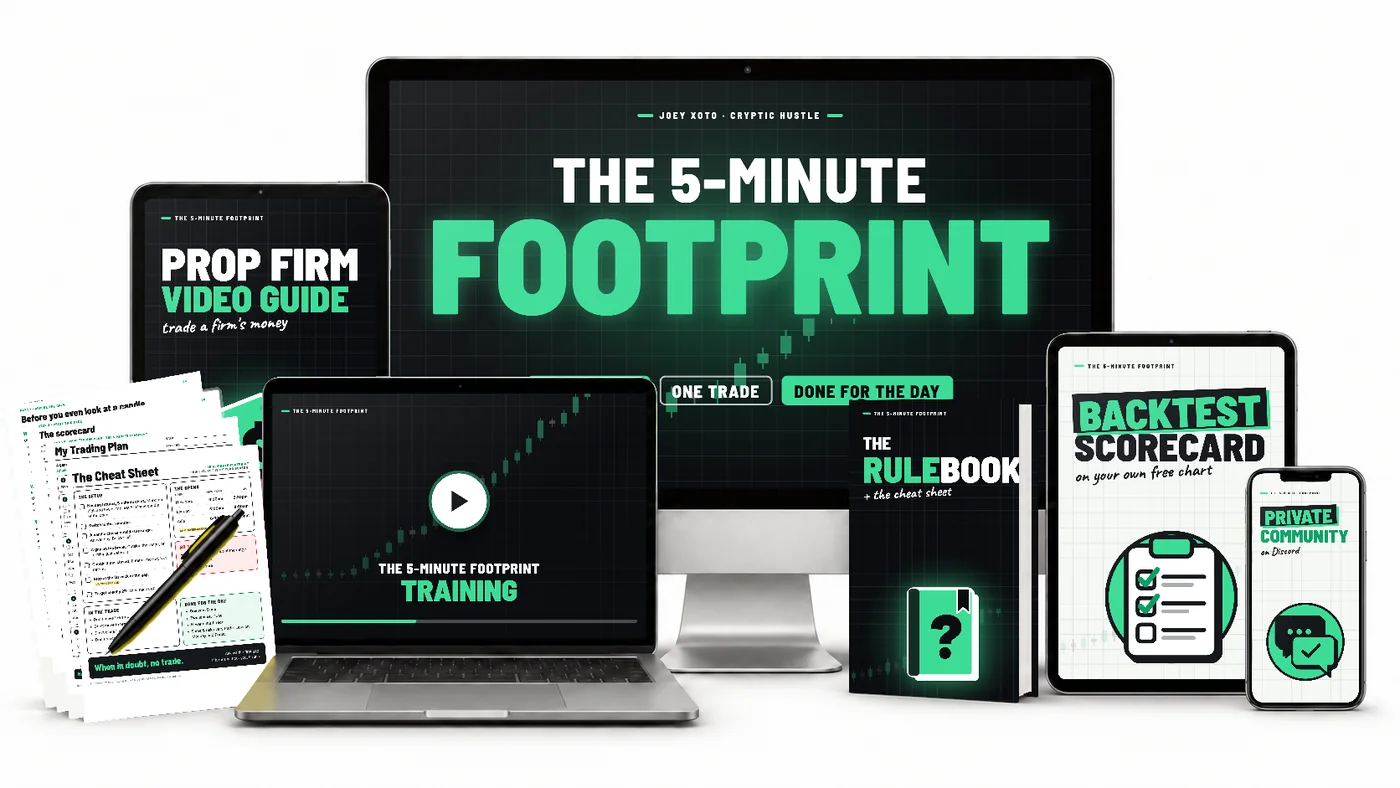
Get it now for $27Instant access · watch it tonight14-day money-back guarantee
Two kinds of people buy this
- You want signals to copy. I don't do that. I don't want to be your crutch. I want to show you how to do this yourself.
- You want to get rich by Friday.
- You want to trade all day.
And let me be straight about what this isn't. This isn't a get-rich-quick promise. This isn't a 90% win rate claim. This isn't signals or trades to copy. It's one setup, three rules, and maths that works even when you're wrong more often than you're right.
Why I'm giving you this for $27
I'm Joey. I've been trading since 2017.
For my first five years I did everything you're not supposed to do. Indicators, bots, signals. Between 2017 and 2022 I blew more than 30 prop firm evaluations. I once lost 20 accounts on a single trade.
Today I trade around 40 prop firm accounts, about $3.5 million in funding, plus my own money. And I post the bad days in our community too, not just the good ones.
DA JOEY: la sua storia con questo modello. Quando ha cominciato a usarlo, perché, la prima volta che ha funzionato, una volta che non ha funzionato.
This is the first setup I give everyone. Not because it's the only thing I do, but because it's the simplest thing that works on its own. I use it myself. DA JOEY: quante volte a settimana
If you're reading this thinking "this is the last one", I hear you. That's exactly why I made it simple enough that there's nothing left to overthink.